Showing posts with label power tool maintenance. Show all posts

Wednesday, March 12, 2014

How to Break in a Small Engine

When you get a new chainsaw, cut off saw, lawn mower, or other small engine powered piece of equipment, it's critical to break the engine in so it runs properly. The reason behind this is that you want to heat the engine up to seal the piston rings to the cylinder wall, which will minimize friction in the cylinder and prevent oil from gathering in the cylinder wall. For this reason, it's also important to break in your engine again if you replace the piston rings.

So how do you break a small engine in exactly?

1. Fill the engine with the recommended oil

Your owner's manual will specify what type of oil to put in your power equipment. For two-stroke engines, we recommend using Lucas 2-Cycle Semi-Synthetic Oil. Lucas oil is formulated with a blend of mineral oil, synthetic oil, and low ash additives that allows fuel to burn thoroughly for smoother engine operation.

2. Idle the saw for 5 minutes

Start up your engine like normal and let it run idle for a few minutes to get the engine warmed up. You can rev the engine a bit to keep it from shutting down, but you want to make sure the engine is warmed up before running it normally.

3. Run the engine as normal, but not at full throttle

For at least 5 hours, you will want to run your engine as normal but don't hit full throttle just yet. If you do run your engine at full throttle, you risk deformation of the cylinder bores. After this period, it's okay to run the engine at full throttle when it has a load. Many chainsaw operators recommend only running the saw at full throttle when the saw is in the cut, for example.

4. Change the oil

Some chainsaw operators and technicians recommend changing the oil in a new saw after an hour of operation. Most new saw owner's manuals will tell you to change the oil after 5 hours of operation. If you want to be extra safe, you can do both, but generally speaking, changing your oil after 5 hours is sufficient. The reason for this oil change is to remove any tiny debris that has broken away from the engine components and remained trapped in the oil.

Once the saws oil has been changed after the 5 hour threshold, your saw is ready to use regularly and at full throttle. Many technicians and small engine experts have their own methods of breaking in their engines. Please leave your comments with your own method!

HLSupply provides small engine parts for chainsaws, mowers, cut off saws, and more. Visit our store for our complete selection of parts including cylinders & piston rings.
Monday, March 3, 2014

Understanding Your Power Tools: How Do Two Stroke Engines Work?

Understanding how your small engine works is critical to keeping it properly maintained and in working order. Two stroke engines can be especially susceptible to malfunctions, and learning about how they work will help you understand why.

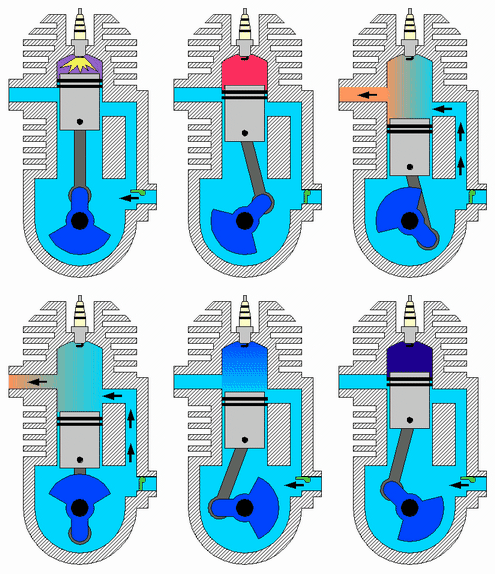
Two stroke engines are internal combustion engines. This means the combustion of fuel occurs in a chamber (in our case, a cylinder) to create force to another part of the engine (a piston). There are 5 steps that are a part of all combustion engines.

1. Intake: When both air and fuel enter the engine. In the case of a power tool, this would be oxygen and the mixture of gasoline and two-stroke engine oil that you use to fuel your power equipment.

2. Compression: When the air and fuel are compressed into a small volume. In a small engine, the piston forces the fuel and air into the cylinder creating compression.

3. Ignition: When the air and fuel are burned. This occurs by the spark plug creating a spark and igniting the fuel and oxygen.

4. Power: The ignition creates energy, and therefore, power. This pushes the piston back down, allowing it to turn the crankshaft and begins to repeat the process.

5. Exhaust: The leftover gas from the ignition of the fuel and oxygen mixture exits the engine. The process is then repeated.

Here is an illustration of how this five step process works:


You might be wondering how a two-stroke engine compares to a four-stroke engine as far as gas flow is concerned. In a two-stroke engine, the flow of gas requires a seamless flow pattern to avoid any turbulent mixing of the spent charge (combusted fuel mixture) with the new charge (fresh fuel mixture). Scavenging is critical in a two stroke engine to ensure that a fresh fuel and air mixture is used in the next cycle, as defined in the 5 step process above.


Scavenging is an essential part of having a properly running engine. When this function isn’t performed properly, exhaust fumes will combine with the fresh mixture, diluting the fresh air and gas of its combustibility and causing a poorly running engine.

The reason that this information is important for operators of two-stroke engines is because proper scavenging is more difficult to achieve in a two-stroke engine making them more prone to problems. Understanding the process will help you diagnose engine issues more easily and allow you to properly install your small engine parts.

Contact us if you have any questions about installing your new small engine replacement parts from HLSProParts.com and we will be happy to help where we can!

Friday, February 14, 2014

4 Handy Chainsaw Tools

Proper chainsaw maintenance often requires specific small engine and chainsaw tools that aren’t found in a normal toolbox. If you’re a professional or avid chainsaw user, keeping these tools handy will give you the peace of mind of knowing that you can address most problems with your saw and keep it regularly maintained to run smoothly during every job.

1. Chain Sharpening Tools

There are several ways to sharpen a chainsaw, but no matter what method you choose, it’s important to keep your chain sharp. The simplest and most versatile tool to carry with you or keep in your toolbox is a file. If you have the luxury of a garage or shed with a workbench, a vice will make sharpening your chain much easier.

2. Clutch Removal Tool

When your clutch or drive sprocket needs replacing, you will need a clutch removal tool, and typically the exact tool you need is dependent on your saw’s make and model. Most clutch removal tools come with a 19mm nut fitting so that you can easily attach a socket or bar wrench to remove the clutch. The following tools are available from HLSupply:

3. Carburetor Adjustment Tool

Carburetors occasionally need to be adjusted for the engine to run properly. The exact tool you use is dependent on the make of your chainsaw. Many of these tools are available to certified maintenance and repair centers only, but they can often be found second hand through many sources. If you are a certified repair technician, check out our selection.

4. T-Wrench

A simple tool to have on hand is a t-wrench. T-wrenches can serve many functions. This wrench, for example, has a 19mm and 13mm socket wrench and a flat head screwdriver. For quick maintenance jobs, this is one of the handiest tools around.

HLSupply is home to a huge selection of tools for your power equipment and small engines. Visit our store for our entire selection of small engine parts.

Monday, January 6, 2014

What to Check if Your Chainsaw Won't Start

If you've given the pull cord on your chainsaw a few pulls to no avail, you might consider bringing your chainsaw into a service center to get it looked at. Before you jump the gun on getting your chainsaw fixed, however, you should do a simple check of a few components on your chainsaw to determine if you really need to spend the money on a professional.

Check gas tank: Obviously if there isn't gas in the tank, your saw won't start, but your gas could also be old. If you haven't stored your chainsaw properly, you will have to get rid of old fuel and refuel your chainsaw. If you have a habit of letting your chainsaw sit for long periods, add Star Tron Enzyme Treatment to your gas so that it won't go bad as quickly.

Check spark plugs: An old spark plug is a cheap and easy fix, so you can easily change it without getting a professional involved. Check your chainsaws manual for the type of spark plug you need. There is a good chance it is a Bosch WSR6F.

Check air filter: If your air filter is clogged, your engine might not be getting the air it needs to run. Usually you can simply clean your air filter with a brush or compressed air to get it working properly, but if it is damaged you will want to replace it as soon as possible to avoid getting debris in your engine.

Clean your chainsaw: You will also want to clean your chainsaw and make sure there isn't any extra debris interfering with starting it. Check out our chainsaw cleaning guide for instructions on how to properly clean your chainsaw.

If your saw still won't start, it might be time to bring the saw into a professional that can check out your carburetor, fuel lines, timing and compression and get your saw up and running.

HLSupply carries a wide selection of chainsaw parts and supplies for trusted brands including Stihl, Husqvarna, Poulan, Jonsered, and more.

Monday, December 30, 2013

How to Extend the Life of a Diamond Saw Blade

Everyone wants to get more out of their equipment. Whether it's properly maintaining your engine, cleaning your power tools correctly, or storing your chainsaw properly, we go to great lengths to make sure our tools are in working order when we need them. Not only will extending the life of your diamond saw blade save you money on expensive replacement blades, but it also reduces extra stress on your engine, extending the overall life of your cut-off saw. Read on for five steps to extending your cut-off saw blades.

1. Use the correct diamond blade for your saw and cutting technique

Many blades are either designed for wet or dry cutting only. Before you start using a particular technique, be sure that your saw blade is designed to be used that way. At HLSProParts.com we carry Ox Diamond Saw Blades, which are designed for both wet and dry cutting.

2. Let the blade cool at regular intervals

It's not a mystery that concrete saw blades get hot. If you want to extend the life of your blade, it's crucial that you don't make continuous cuts with an overheated blade. This is more important for dry cutting than wet cutting. After a few cuts, let the saw run freely so that the blade can cool down and then you can resume the job.

3. Make sure your water supply is operating correctly

If you are wet cutting, make sure your water supply is giving you enough water to prevent excessive friction on your blade, which will cause your blade to wear too quickly by stripping away layers of diamonds before they have been fully used.

4. Let the blade do the work———don't force it

It's important to let your tools do their job. By forcing your saw through whatever material you are cutting, you are putting excessive pressure on the blade and not allowing the diamonds to make the cut. This not only will dull your saw more quickly, but makes your work physically harder. If your saw is cutting slowly, it might be time to sharpen your blade. Which leads us to...

5. Keep your blade sharp

Keeping the blade sharp is critical to extending the life of your blade. Check out our blog on sharpening diamond saw blades for step by step instructions on how to do this. This will make your cuts easier, relieve stress on your engine, and help get your jobs done faster.

Thursday, November 21, 2013

Bosch WSR6F Spark Plug Product Feature

One of our most popular products at HLSupply is the Bosch WSR6F Spark plug. This particular spark plug fits many power tools including trimmers, edgers, blowers, chainsaws, and cut off saws from brands including Stihl, Husqvarna, Jonsered, Husky, Echo, and many more. In fact, this is the OEM spark plug for many of these tools and we recommend checking your owner's manual because it's likely you will find the Bosch WSR6F is the suggested spark plug for your power tool.

If your owner's manual doesn't recommend a Bosch WSR6F spark plug, you may still be able to use it. This plug replaces NGK BPM7A, NGK BPMR6A, Champion CJ7Y, and Champion RCJ6Y spark plugs as well, which are the most commonly used spark plugs throughout the major power tool brands.

As such, we have found that the WSR6F works just as well as the spark plugs installed at the factory. Your power tools will run just as they were designed to using one of these spark plugs, which means reliability throughout even the most intense jobs. There are more expensive plugs available, but if your power tool was designed with the WSR6F in mind, and you haven’t made any significant modifications to your engine, this is the only plug you will need.

Replacing your power tools' spark plugs regularly is important to the life and efficiency of your engine and at an affordable price of $2.79 per plug at HLSProParts.com, there's no reason to let a simple spark plug change linger and risk damaging your tools. We are also happy to offer 20% off purchases of 5 or more Bosch WSR6F spark plugs, so you can stock up for the whole year or replenish your entire team's supplies at a great price.

Visit our ignition parts page for everything you need to get your chainsaw, cut off saw, trimmer, blower, or other power tool up and running. Please don't hesitate to get in touch with us by email or through our Facebook page if you have any questions about specific tools. We are always happy to help!

Friday, October 25, 2013

Storing Your Chainsaw for Winter

Storing gas power tools for an extended period of time it's important for making sure your tools are ready to go the following season. If you won't be using your chainsaw over the winter, follow these steps to properly winterize your chainsaw.

Empty the Fuel Tank

There are a couple ways you can empty your fuel tank. Most fuel today has a short shelf like because it contains ethanol. Some high quality, high octane fuels or fuels treated with a treatment such as Star Tron Enzyme Treatment can be stored safely for up to 2 years, but generally speaking, you will want to remove the fuel both for safety reasons and because fuel can thicken over time, doing damage to your carburetor.

Remove the fuel from your tank and add a small amount of high grade, ethanol free fuel, or fuel that has been treated with a fuel stabilizer back into your tank. Start the chainsaw 10 feet from where you were removing and adding fuel, and let it run until the engine stops.

Clean the Saw

What's better than firing up a freshly cleaned chainsaw next season? Cleaning your chainsaw and all its components might not be entirely necessary, but it will ensure that your saw is ready to go next season. At the very least you will want to remove the bar and chain and wipe them down to prevent any rusting or corrosion. You will also want to wipe the bar and chain down with WD-40 or another rust preventing oil. Check out our chainsaw cleaning guide for more tips on getting your saw in top shape.

Store Properly

Storing your saw in a dry place is crucial to keeping all of the components corrosion free. In addition to keeping moisture away from your saw, you don't want any dust or debris building up on your chainsaw throughout storage. If your chainsaw came with a case, store it in the case or find a relatively air tight container to put the saw in that will keep dust out.

If you follow these steps, by the time next season rolls around, your chainsaw will be ready to go!

HLSupply.com supplies quality aftermarket chainsaw parts and supplies for a number of makes and models including Stihl, Husqvarna, Partner, and more.

Tuesday, October 22, 2013

Cutting Wet Wood with a Chainsaw

Winter is rapidly approaching, and with it, wet conditions. Between autumn rain and eventually winter snow, working with a chainsaw in wet weather is inevitable. Here are a few tips for cutting wet wood with a chainsaw:

  • Cutting wood in rain or snow is okay for your saw: If you're nervous about your saw getting wet, don't worry. Gas powered chainsaws are perfectly okay to use in wet weather; the same is true for the log itself. Cutting through wet wood is fine for your chain and bar, though there might be some extra build up from wet saw dust. It's nothing you can't clean off with a rag, though.
  • Check your air filter: Speaking of wet build up, your engine's air filter could potentially be subject to wet debris getting caught in it. If the engine feels like it's not running correctly or it's struggling, check the air filter for any debris.
  • Be wary of slippery conditions: Obviously when surfaces are wet (or icy), things can get slippery. It's important to make sure you have solid footing when you're working in the rain or snow and make sure you have a solid grip on the saw at all times.
  • Use weather appropriate clothing & protective equipment: Wet weather boots and gloves with extra grip will go a long way in avoiding any mishaps. Wearing warm and water resistant clothing will also ensure that you're comfortable and can stay focused on the job.
  • Use the correct type of chain for frozen wood: Not all chains serve the same purpose, and for frozen logs you will need one with semi-chisel teeth. These rounded teeth cut at a slightly slower pace, but you won't have to stop and sharpen your chain in the middle of a job because your chain is dull. Check out our blog post on chainsaw teeth for more information on chain types.
  • Be wary of debris frozen to the bark: Cutting through dirt and rocks won't go well for your chainsaw chain. Make sure the logs you're cutting don't have a lot of debris frozen to them, particularly on the bottom of the log where you wouldn't see it.

Here are some things to consider before sharpening a chainsaw with a round file.

HLSupply.com provides quality aftermarket chainsaw parts from both new and discontinued chainsaws, and also carries a variety of parts for other power equipment including blowers, concrete saws, and rammers.

Friday, August 9, 2013

How to Clean a Chainsaw

You take pride in your work and you should also take pride in your tools. Regularly cleaning your chainsaw is important for keeping the chainsaw running smoothly, not mention keeping it from stalling in the middle of a job. Here's what you'll need to get your saw as clean as the day you bought it:

  • Air compressor
  • A set of chainsaw tools
  • General cleaner
  • Air filter cleaner
  • A towel or rag

1. Remove the drivetrain cover and remove the chainsaw chain & bar: There's not a whole lot of room for sawdust to escape in the drivetrain, so it's likely this will be an area you will have to clean more often. Use an air compressor to blow out all the dirt, dust, and grime in both the sprocket and clutch area and on the drivetrain cover. It doesn't hurt to give the chainsaw bar a quick cleaning as well.

2. Remove the oil port plate: Some compressed air should clean this area out quickly.

3. Remove the clutch cover and clean the components: Carefully unscrew and pry off the plastic clutch cover and blow out the area. Remove the sprocket and clean it off. Disassemble the clutch being careful to keep track of all the pieces, and add some bearing lubrication to the clutch bearing axle. Carefully reassemble these parts when you're done cleaning.

4. Remove the muffler: Unscrew the muffler and clean out the screen. Reassemble when you're done.

5. Clean or replace the air filter: Remove the intake cover and blow off the air filter. Remove the air filter cover and check to make sure the filter isn't damaged. If it is, you'll have to replace it. If it isn't, blow out the air filter from the inside with compressed air, and use air filter cleaner to make sure you remove any stubborn pieces. Air filter lube will also ensure that air will flow freely through the filter and keep debris from sticking to it. Reassemble the intake when you're done.

6. Reassemble the bar and the chain: Finally, put the chainsaw bar and chain back on the saw. It's important to set up your saw with proper chain tension to avoid any mishaps while running your saw.

Now your saw should be ready for any job. If along the way you find any parts that are damaged or have excessive wear, HL Supply has a variety of chainsaw parts for just about any saw you might need.

Wednesday, June 5, 2013

How to Sharpen a Cut-Off Saw Diamond Blade

Maintaining your tools is important to the quality of your work, longevity of your equipment, and your safety. This is especially important for power tools, which can pose a serious risk of injury if they aren’t operating properly. Keeping your cut off saw blades sharp will prolong the life of your saw by making it easy for a saw to cut and putting less stress on the engine. Safety-wise, this will also help reduce kick-back from the blade snagging.
While diamond blades are designed to essentially sharpen themselves by wearing down and revealing new diamonds, sometimes the diamonds become worn to a point that they become smooth, which doesn’t allow them to be stripped away and the new diamonds to take their place. This typically happens when you have been primarily cutting hard, dense materials. To sharpen the blade and bring expose the new diamonds, follow these steps:

Monday, May 13, 2013

Preparing Your Power Tools for Summer

Now that the warmer months are rolling around, it’s time to get your power tools primed and ready for work. Taking them straight out of storage and immediately using them probably isn’t the best way to go, especially if you used your tools extensively the year before. It’s always good to do some preemptive inspections and maintenance of your power tools before using them, so we put together a list of the things you should check before pulling the starter on your chainsaw. As always, be sure to refer to your owner’s manual for anything specific to your equipment. This is the best place to find out how to properly care for your specific tool.

Inspection

The first thing you should do is carefully inspect your equipment. Check for any rusting that resulted from improper winter storage and make a note of parts that need replacement. It’s also important for safety reasons to check for loose nuts and bolts and be sure to tighten them, particularly any safety guards on saws and the deflectors on your hedge trimmers.

Sharpening

For chainsaws and cut off saws, keeping the chain and blade sharp will ensure a properly operating tool and improve its safety. If you haven’t been properly maintaining your chainsaw’s chain, it may be time for a new chain. Broken cutting teeth and worn down teeth and cutters are all signs that you need a new chain. This will also prolong the life of your saw, as the engine won’t have to work as hard when cutting. The same goes for replacement cut off saw blades.

Checking Engine Parts

Making sure the engine is operating properly is the most important part of maintaining your gasoline powered tools. Routine maintenance that should be completed before the summer season includes checking air filters and either cleaning filter debris with filter oil, or replacing any filter that is damaged.

Check other engine parts, including the spark plug, carburetor, fuel filters, and clutch to be sure they are all in working order. If something looks worn, replace it by either checking your owner’s manual or consulting a trusted repair shop. Also be sure to only use parts that are intended to fit your make and model of chainsaw. One of the most important things to do before using your saw is check that the stop button is in working order—you don’t want to be put in a situation that you need to stop the blade from running and find out that you have a busted stop button. Finally, lubricate any moving parts that will be subject to friction.

By properly maintaining your equipment, you will maintain its value and have a long-lasting and well-operating machine.