We get a lot of great photos from our customers and Facebook fans, and we wanted to put them all in one place to make it easy to view. We always love getting chainsaw and cut-off saw pictures from great brands including Stihl, Husqvarna, Jonsered, and more, so please post on our Facebook wall to submit your photos and we will add them to the gallery! And of course, thank you to everyone who has submitted their photos so far!
HLSProParts.com is the best source for small engine parts for a wide selection of power tool makes and models. Visit our chainsaw parts store for parts for your favorite brands, or contact us if you have any questions.Tuesday, May 13, 2014
Friday, May 9, 2014
Top 10 Summer Lawn Care Tips

The summer months are when you’ll be enjoying your yard the most, and if it doesn’t look up to your standards, it might be difficult to enjoy it. Follow these top 10 yard care tips to keep your yard and landscaping looking fresh throughout the summer.
1. Water deeply: About 1 to 1.5 inches each time you water your lawn is sufficient, and will give your grass the sustenance it needs to grow deep, healthy roots.
2. Water infrequently: To conserve water, it’s important that you only water your lawn when it needs it. This is going to depend significantly on the climate you live in, but a few signs that you need to water are a bluish-green tint to the grass and footprints lasting longer normal in the grass.
3. Water early in the morning: By watering in the early morning between 4 and 9 a.m., you’re giving the soil a chance to absorb the water before it evaporates. This increases with wind as well.
4. Keep your grass 3 inches or higher: The summer heat will take a toll on short lawns. Setting your mower to cut your grass 3 inches or higher gives protection to the roots and allows them to grow deeply.
5. Mow your lawn often: Mowing often will ensure that your lawn doesn’t get too long and gives shorter blades room to grow.
6. Look out for pests: If your lawn or landscaping isn’t growing properly, make sure that you don’t have a pest problem.
7. Use mulch in your landscaping: Mulching around your landscaping will help the underlying soil retain water and will protect the roots of your trees, shrubs, and flowers from hot and cold weather.
8. Only mulch up to 4 inches: Four inches is fairly thick for mulching, and you will generally only need about a 1 to 2 inch layer. Layering mulch thicker than 4 inches can restrict oxygen to the plant roots and should be avoided.
9. Address weeds in late April and May: Weeds can be removed by hand from your landscaping, but for weeds throughout your lawn, you should apply herbicide only during late April and May. Applying herbicide in the summer can damage your entire lawn due to heat.
10. Use all of the above tips to prevent weeds: A healthy lawn is the best way to prevent weeds. A thick, lush lawn and properly mulched landscaping will make it difficult for weeds to germinate.
Do you have any other summer lawn and landscaping tips? Leave us your thoughts in the comments!
Get your lawn mower in working order with small engine parts from HLSProParts.com. From carburetors to pistons to oil, HLS has the parts and supplies you need.Friday, May 2, 2014
What Do Foresters Do?
The timber industry in the United States is a vast industry with dozens of different jobs dependent on the health and sustainability of our forests. Foresters (also known as conservation scientists) are tasked with the job of making sure this happens.
You might think that many conservation scientists are there to create restrictions on loggers and make their lives just a little bit more difficult. While it's true that the majority of forestry jobs are through the public sector, many foresters are also employed or contracted by companies within the forest product industry. They might be hired to ensure that they are using sustainable practices, to accurately measure the amount of timber within a particular amount of land, and even to purchase timber for the company.
So let's take a deeper look into what these professionals actually do and how it relates to the timber industry.
Conservation & Resource Management
Due to the lifespan of trees, the timber industry operates on a lengthy production cycle that can last 10 years or more. Foresters have to be able to think far into the future and determine the best ways to conserve and manage timber throughout the cycle. Conservation & resource management foresters may have to predict and protect against anything from potential pest threats to soil contamination to erosion. It's also necessary to determine how much of a particular forest can be harvested without harming the remaining ecosystem.
Procurement Foresters
Some companies will hire foresters to negotiate the purchase of timber from private forests. Many times private landowners are willing to sell the timber that has grown on their land, or they may be growing forests specifically for that purpose. A forester is tasked with determining how much the timber on the land is worth to the company and then creating a strategy to remove the timber according to the terms of the contract they negotiate.
Restoration Planners
Similar to conservation and resource management foresters, restoration managers research ways to improve sustainability and conservation. They may develop better harvesting procedures and strategies, tree improvement techniques, and ways to protect forests from disease, wildfire, and pests. Restoration planners might also monitor and prepare cleared forests for regeneration so the land can be used again.
In addition to these specialties, foresters also have to be knowledgeable in government regulations regarding forests, even if they are on private land. There are ethical considerations to make as well, particularly in regards to habitat protection. In fact, many foresters get into their line of work because they enjoy working to preserve nature and make sure we are using sustainable practices.
If you're a forester or are thinking about becoming one, drop us a comment and let us know about your experiences!
Monday, April 7, 2014
10 Cool Chainsaw Carving Sculptures
Chainsaw carving is one of the most dangerous art forms, but when a chainsaw is in the hands of a skilled artist, the results can be beautiful. Check out ten awesome chainsaw carving sculptures from some of the most skilled artists around the world.
1. Dragon Head
This carving from Matthew Crabb is has some the most intricate detail we have ever seen in a chainsaw carving. Crabb is one of the most skilled carvers in the world and regularly posts his creations to his Facebook page.

2. Bald Eagle
Bob King, known as the Chainsaw King, is a skilled carver and member of the Echo Carving Team. His work is distinctly American, with eagles, bears, and other North American wildlife as the subject.

3. Battlefield Cross
Mark Colp is another member of the Echo Carving Team, and this Battlefield Cross carving is one of the most striking we've seen. Echo's website has many examples of his work.

4. Honey Bears
Sculpting thin pieces of wood with a chainsaw isn't the easiest task. We like this carving by Cherie from ChainsawChick.com both for its creativity and risky nature.

5. Brookfield Zoo Bench
Jason Emmons of the Echo Carving Team combines form and function in this bench for the Brookfield Zoo in Chicago.
6. Abstract Chair
Another great piece of furniture we found on YouTube with a freeform design. Watching the artist in action gives you an idea of just how much work goes into a project like this.
7. Octobench
Jesse Toso is a woodworker out of Vancouver and carved this piece at the Canadian Carva-Palooza where it was auctioned off. There's a cool time lapse video of the carving here too.

8. Praying Over You
The detail in this praying mantis carving is unparalleled and the reason Chris Foltz won the Chetwynd Chainsaw Carving Championship in 2012. Some of the most skilled chainsaw carvers in the world attend this championship every year.

9. Guan Gong
Jeff Samudosky won first prize in the 2013 Chetwynd Chainsaw Carving Championship with his depiction of Chinese General Guan Gong.

10. Kingfisher
These carvings apparently turned up in North Yorkshire, UK with little explanation as to who the artist was. The artist has since been identified as Tommy Craggs.

Have you seen any other cool chainsaw carvings? Drop us a link in the comments or visit us on Facebook to show us some cool work.
Tuesday, March 25, 2014
How to Mix Chainsaw Fuel
Two stroke engines require an oil and fuel mixture for the engine to run properly. The reason for this is that most two stroke engines don't have separate lubrication systems, so the fuel has to also provide lubrication to the moving parts of the engine.
One of the reasons that two stroke engines produce more smoke than four stroke engines is because of this—the engine is burning oil as well as fuel. Most modern two stroke engines suggest a 50:1 gasoline-to-oil ratio to power the engine. Some chainsaw operators feel more comfortable using extra oil in their mixtures because it provides additional lubrication, but this could also cause heavier smoke than normal. In any case, you should check your owner’s manual for the recommended ratio, or if you have an old chainsaw, mix a higher ratio such as 40:1 or 30:1 just to be on the safe side.
Here is the process:
- Get two stroke engine oil, such as Lucas Two Cycle Oil, and unleaded, 89 octane (or higher) gasoline. It's important to use two-stroke engine oil only because it is specially formulated for two-stroke engines to prevent build up in the engine.
- Measure out your ratio according to the recommended amount. This calculator is a handy way to figure out the exact measurement of oil in ounces you need for the corresponding amount of gas in gallons. The corresponding measurements for 50:1 are 2.6 ounces of oil for every gallon of gas.
- To mix the solution effectively, you can add half the amount of gas and the full amount of oil to a gas container and shake the container. Add the rest of the gas and shake again. Don't try to mix the oil and gas in the fuel tank of your chainsaw, as it will be difficult to get the measurements right. You will also want to mix more than will fit in your chainsaw's gas tank so you have some extra on hand for refueling later.
- As an optional step, you can add a fuel enzyme treatment that will stabilize your fuel and ensure that your gasoline stays good for up to 2 years. Many gasolines now contain ethanol, and enzyme treatment will help to stabilize your fuel and prevent problems that arise from ethanol containing fuel.
- Now it’s time to fill up your fuel tank. There are a few things to remember when fueling your chainsaw:
- Always wipe up any excess spillage on your chainsaw.
- Start your machine at least 10 feet away from where you refueled.
- Always start your chainsaw in a very well-ventilated area.
If you have various cans of gasoline, it doesn't hurt to label the can you just mixed with the ratio to help you remember what mixture you made in that can. You should also always shake the container before refueling your chainsaw because the oil and gas will become separated after the mixture settles.
And if you suspect you need any new parts for your chainsaw to get it up and running, don't hesitate to contact us or visit our store to get everything you need.
Wednesday, March 12, 2014
How to Break in a Small Engine
When you get a new chainsaw, cut off saw, lawn mower, or other small engine powered piece of equipment, it's critical to break the engine in so it runs properly. The reason behind this is that you want to heat the engine up to seal the piston rings to the cylinder wall, which will minimize friction in the cylinder and prevent oil from gathering in the cylinder wall. For this reason, it's also important to break in your engine again if you replace the piston rings.
So how do you break a small engine in exactly?

1. Fill the engine with the recommended oil
Your owner's manual will specify what type of oil to put in your power equipment. For two-stroke engines, we recommend using Lucas 2-Cycle Semi-Synthetic Oil. Lucas oil is formulated with a blend of mineral oil, synthetic oil, and low ash additives that allows fuel to burn thoroughly for smoother engine operation.
2. Idle the saw for 5 minutes
Start up your engine like normal and let it run idle for a few minutes to get the engine warmed up. You can rev the engine a bit to keep it from shutting down, but you want to make sure the engine is warmed up before running it normally.
3. Run the engine as normal, but not at full throttle
For at least 5 hours, you will want to run your engine as normal but don't hit full throttle just yet. If you do run your engine at full throttle, you risk deformation of the cylinder bores. After this period, it's okay to run the engine at full throttle when it has a load. Many chainsaw operators recommend only running the saw at full throttle when the saw is in the cut, for example.
4. Change the oil
Some chainsaw operators and technicians recommend changing the oil in a new saw after an hour of operation. Most new saw owner's manuals will tell you to change the oil after 5 hours of operation. If you want to be extra safe, you can do both, but generally speaking, changing your oil after 5 hours is sufficient. The reason for this oil change is to remove any tiny debris that has broken away from the engine components and remained trapped in the oil.
Once the saws oil has been changed after the 5 hour threshold, your saw is ready to use regularly and at full throttle. Many technicians and small engine experts have their own methods of breaking in their engines. Please leave your comments with your own method!
HLSupply provides small engine parts for chainsaws, mowers, cut off saws, and more. Visit our store for our complete selection of parts including cylinders & piston rings.Monday, March 3, 2014
Understanding Your Power Tools: How Do Two Stroke Engines Work?
Understanding how your small engine works is critical to keeping it properly maintained and in working order. Two stroke engines can be especially susceptible to malfunctions, and learning about how they work will help you understand why.
Two stroke engines are internal combustion engines. This means the combustion of fuel occurs in a chamber (in our case, a cylinder) to create force to another part of the engine (a piston). There are 5 steps that are a part of all combustion engines.
1. Intake: When both air and fuel enter the engine. In the case of a power tool, this would be oxygen and the mixture of gasoline and two-stroke engine oil that you use to fuel your power equipment.
2. Compression: When the air and fuel are compressed into a small volume. In a small engine, the piston forces the fuel and air into the cylinder creating compression.
3. Ignition: When the air and fuel are burned. This occurs by the spark plug creating a spark and igniting the fuel and oxygen.
4. Power: The ignition creates energy, and therefore, power. This pushes the piston back down, allowing it to turn the crankshaft and begins to repeat the process.
5. Exhaust: The leftover gas from the ignition of the fuel and oxygen mixture exits the engine. The process is then repeated.
Here is an illustration of how this five step process works:
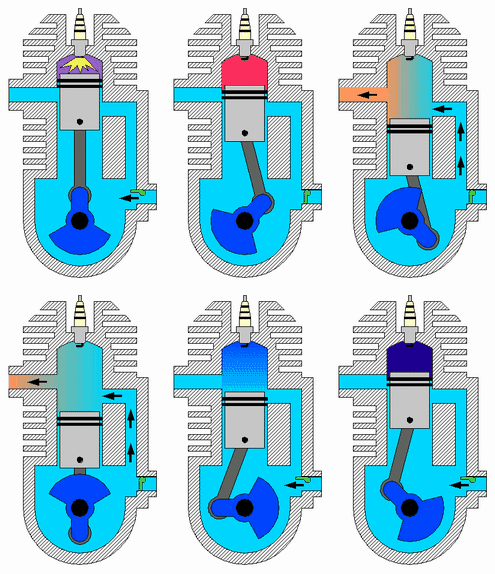
You might be wondering how a two-stroke engine compares to a four-stroke engine as far as gas flow is concerned. In a two-stroke engine, the flow of gas requires a seamless flow pattern to avoid any turbulent mixing of the spent charge (combusted fuel mixture) with the new charge (fresh fuel mixture). Scavenging is critical in a two stroke engine to ensure that a fresh fuel and air mixture is used in the next cycle, as defined in the 5 step process above.
Scavenging is an essential part of having a properly running engine. When this function isn’t performed properly, exhaust fumes will combine with the fresh mixture, diluting the fresh air and gas of its combustibility and causing a poorly running engine.
The reason that this information is important for operators of two-stroke engines is because proper scavenging is more difficult to achieve in a two-stroke engine making them more prone to problems. Understanding the process will help you diagnose engine issues more easily and allow you to properly install your small engine parts.
Contact us if you have any questions about installing your new small engine replacement parts from HLSProParts.com and we will be happy to help where we can!
Subscribe to:
Posts (Atom)