Tuesday, March 25, 2014

How to Mix Chainsaw Fuel

Two stroke engines require an oil and fuel mixture for the engine to run properly. The reason for this is that most two stroke engines don't have separate lubrication systems, so the fuel has to also provide lubrication to the moving parts of the engine.

One of the reasons that two stroke engines produce more smoke than four stroke engines is because of this—the engine is burning oil as well as fuel. Most modern two stroke engines suggest a 50:1 gasoline-to-oil ratio to power the engine. Some chainsaw operators feel more comfortable using extra oil in their mixtures because it provides additional lubrication, but this could also cause heavier smoke than normal. In any case, you should check your owner’s manual for the recommended ratio, or if you have an old chainsaw, mix a higher ratio such as 40:1 or 30:1 just to be on the safe side.

Here is the process:

  1. Get two stroke engine oil, such as Lucas Two Cycle Oil, and unleaded, 89 octane (or higher) gasoline. It's important to use two-stroke engine oil only because it is specially formulated for two-stroke engines to prevent build up in the engine.
  2. Measure out your ratio according to the recommended amount. This calculator is a handy way to figure out the exact measurement of oil in ounces you need for the corresponding amount of gas in gallons. The corresponding measurements for 50:1 are 2.6 ounces of oil for every gallon of gas.
  3. To mix the solution effectively, you can add half the amount of gas and the full amount of oil to a gas container and shake the container. Add the rest of the gas and shake again. Don't try to mix the oil and gas in the fuel tank of your chainsaw, as it will be difficult to get the measurements right. You will also want to mix more than will fit in your chainsaw's gas tank so you have some extra on hand for refueling later.
  4. As an optional step, you can add a fuel enzyme treatment that will stabilize your fuel and ensure that your gasoline stays good for up to 2 years. Many gasolines now contain ethanol, and enzyme treatment will help to stabilize your fuel and prevent problems that arise from ethanol containing fuel.
  5. Now it’s time to fill up your fuel tank. There are a few things to remember when fueling your chainsaw:
    • Always wipe up any excess spillage on your chainsaw.
    • Start your machine at least 10 feet away from where you refueled.
    • Always start your chainsaw in a very well-ventilated area.

If you have various cans of gasoline, it doesn't hurt to label the can you just mixed with the ratio to help you remember what mixture you made in that can. You should also always shake the container before refueling your chainsaw because the oil and gas will become separated after the mixture settles.

And if you suspect you need any new parts for your chainsaw to get it up and running, don't hesitate to contact us or visit our store to get everything you need.

Wednesday, March 12, 2014

How to Break in a Small Engine

When you get a new chainsaw, cut off saw, lawn mower, or other small engine powered piece of equipment, it's critical to break the engine in so it runs properly. The reason behind this is that you want to heat the engine up to seal the piston rings to the cylinder wall, which will minimize friction in the cylinder and prevent oil from gathering in the cylinder wall. For this reason, it's also important to break in your engine again if you replace the piston rings.

So how do you break a small engine in exactly?

1. Fill the engine with the recommended oil

Your owner's manual will specify what type of oil to put in your power equipment. For two-stroke engines, we recommend using Lucas 2-Cycle Semi-Synthetic Oil. Lucas oil is formulated with a blend of mineral oil, synthetic oil, and low ash additives that allows fuel to burn thoroughly for smoother engine operation.

2. Idle the saw for 5 minutes

Start up your engine like normal and let it run idle for a few minutes to get the engine warmed up. You can rev the engine a bit to keep it from shutting down, but you want to make sure the engine is warmed up before running it normally.

3. Run the engine as normal, but not at full throttle

For at least 5 hours, you will want to run your engine as normal but don't hit full throttle just yet. If you do run your engine at full throttle, you risk deformation of the cylinder bores. After this period, it's okay to run the engine at full throttle when it has a load. Many chainsaw operators recommend only running the saw at full throttle when the saw is in the cut, for example.

4. Change the oil

Some chainsaw operators and technicians recommend changing the oil in a new saw after an hour of operation. Most new saw owner's manuals will tell you to change the oil after 5 hours of operation. If you want to be extra safe, you can do both, but generally speaking, changing your oil after 5 hours is sufficient. The reason for this oil change is to remove any tiny debris that has broken away from the engine components and remained trapped in the oil.

Once the saws oil has been changed after the 5 hour threshold, your saw is ready to use regularly and at full throttle. Many technicians and small engine experts have their own methods of breaking in their engines. Please leave your comments with your own method!

HLSupply provides small engine parts for chainsaws, mowers, cut off saws, and more. Visit our store for our complete selection of parts including cylinders & piston rings.

Monday, March 3, 2014

Understanding Your Power Tools: How Do Two Stroke Engines Work?

Understanding how your small engine works is critical to keeping it properly maintained and in working order. Two stroke engines can be especially susceptible to malfunctions, and learning about how they work will help you understand why.

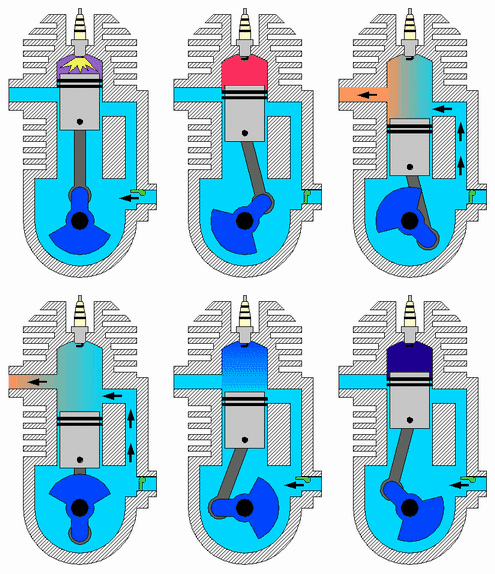
Two stroke engines are internal combustion engines. This means the combustion of fuel occurs in a chamber (in our case, a cylinder) to create force to another part of the engine (a piston). There are 5 steps that are a part of all combustion engines.

1. Intake: When both air and fuel enter the engine. In the case of a power tool, this would be oxygen and the mixture of gasoline and two-stroke engine oil that you use to fuel your power equipment.

2. Compression: When the air and fuel are compressed into a small volume. In a small engine, the piston forces the fuel and air into the cylinder creating compression.

3. Ignition: When the air and fuel are burned. This occurs by the spark plug creating a spark and igniting the fuel and oxygen.

4. Power: The ignition creates energy, and therefore, power. This pushes the piston back down, allowing it to turn the crankshaft and begins to repeat the process.

5. Exhaust: The leftover gas from the ignition of the fuel and oxygen mixture exits the engine. The process is then repeated.

Here is an illustration of how this five step process works:


You might be wondering how a two-stroke engine compares to a four-stroke engine as far as gas flow is concerned. In a two-stroke engine, the flow of gas requires a seamless flow pattern to avoid any turbulent mixing of the spent charge (combusted fuel mixture) with the new charge (fresh fuel mixture). Scavenging is critical in a two stroke engine to ensure that a fresh fuel and air mixture is used in the next cycle, as defined in the 5 step process above.


Scavenging is an essential part of having a properly running engine. When this function isn’t performed properly, exhaust fumes will combine with the fresh mixture, diluting the fresh air and gas of its combustibility and causing a poorly running engine.

The reason that this information is important for operators of two-stroke engines is because proper scavenging is more difficult to achieve in a two-stroke engine making them more prone to problems. Understanding the process will help you diagnose engine issues more easily and allow you to properly install your small engine parts.

Contact us if you have any questions about installing your new small engine replacement parts from HLSProParts.com and we will be happy to help where we can!

Friday, February 28, 2014

Best Chainsaw Models for Home Use

The large majority of chainsaw users aren't professionals—they simply use their chainsaws around their home's yard to prune landscape, cut down small trees, or cut up the occasional fallen tree. Generally speaking, home use chainsaws are going to be on the lower end of the power spectrum with a short bar. Read on for 5 of our favorite homeowner chainsaw models from Stihl, Poulan, Homelite, Poulan & Jonsered.

Husqvarna 240e

With a 38.2 cc engine displacement and the ability to handle chain bars from 13 to 16 inches, the Husqvarna 240e is right in the homeowner range. The 240e includes a couple features that the 240 doesn't. First is has Husqvarna's "Smart Start" starter and engine which allows the saw to be started with minimal effort, which is great for homeowners that are looking for a low hassle product. It also includes a built in chain tensioner, so no tools are required when you need to tighten the saw chain.

Poulan P4018

If you're looking for a little bit more power, the Poulan P4018 is a great option, weighing in with a 40 cc engine displacement and an 18" bar length. Another feature that is useful for homeowners is the automatic chain oiler that keeps the chain lubricated throughout your work. Poulan also throws in a carrying case that is useful for storing your saw.

Stihl MS 211 C-BE

Similar to the Husqvarna 240e, the Stihl MS 211 C-BE features Stihl's own quick start technology, Easy2Start™, and also a quick chain adjuster for tightening your chainsaw's chain without any tools. It's important to note that Easy2Start is designed for a leisurely pull—you risk flooding the engine if you pull too hard. At 35.2 cc, this saw is slightly less powerful than the other options, but Stihl's products are designed for use in professional settings, even on their less powerful saws. If you're concerned about power, you can upgrade to the Stihl MS 250 with a 45.4 cc engine and many of the same features as the MS 211 C-BE.

Homelite UT10660

The Homelite UT10660 is a 38 cc chainsaw with a 16 inch bar and a number of features that homeowners will find useful. The automatic oiler, vibration isolation, and chain tensioner all make this saw easy to use on any job. Homelite also includes a removable "Safe-T-Tip™" on the tip of the chain bar that prevents users from cutting with the tip of the saw, which can result in kickback.

Jonsered CS 2240

Jonsered makes some of the most homeowner friendly saws out there. Weighing in at 9.48 pounds it's the lightest chainsaw on our list and with a 40.9 cc engine, has enough power for any job around your home. The CS 2240 also includes the tool-less chain tensioner, a one push stop/start switch, and a quick starting pull cord. The air filter cleaning system also makes the saw easy to maintain.

At HLSupply, we carry a huge selection of aftermarket parts for all of these makes and models. If you need replacement parts for your new homeowner saw, visit our site or contact us to get your saw back in running order with highest quality and best priced parts online.

Friday, February 14, 2014

4 Handy Chainsaw Tools

Proper chainsaw maintenance often requires specific small engine and chainsaw tools that aren’t found in a normal toolbox. If you’re a professional or avid chainsaw user, keeping these tools handy will give you the peace of mind of knowing that you can address most problems with your saw and keep it regularly maintained to run smoothly during every job.

1. Chain Sharpening Tools

There are several ways to sharpen a chainsaw, but no matter what method you choose, it’s important to keep your chain sharp. The simplest and most versatile tool to carry with you or keep in your toolbox is a file. If you have the luxury of a garage or shed with a workbench, a vice will make sharpening your chain much easier.

2. Clutch Removal Tool

When your clutch or drive sprocket needs replacing, you will need a clutch removal tool, and typically the exact tool you need is dependent on your saw’s make and model. Most clutch removal tools come with a 19mm nut fitting so that you can easily attach a socket or bar wrench to remove the clutch. The following tools are available from HLSupply:

3. Carburetor Adjustment Tool

Carburetors occasionally need to be adjusted for the engine to run properly. The exact tool you use is dependent on the make of your chainsaw. Many of these tools are available to certified maintenance and repair centers only, but they can often be found second hand through many sources. If you are a certified repair technician, check out our selection.

4. T-Wrench

A simple tool to have on hand is a t-wrench. T-wrenches can serve many functions. This wrench, for example, has a 19mm and 13mm socket wrench and a flat head screwdriver. For quick maintenance jobs, this is one of the handiest tools around.

HLSupply is home to a huge selection of tools for your power equipment and small engines. Visit our store for our entire selection of small engine parts.

Monday, January 27, 2014

How to Prepare Your Trees for Winter Storms

Those of us living in cold winter climates have experienced this one way or another—a tree or tree branch broken under the stress of a snow storm. Every winter roads are blocked, property is damaged, and people get hurt because of fallen trees, but there are steps you can take to minimize this risk, and also ensure that your trees will remain a part of your landscaping.

Pruning trees for dead or weak branches will not only keep your trees from causing damage, but in younger trees, it will often result in a burst of growth in the spring. This will result in beautiful landscaping and stronger trees in the summer months. Check out our winter tree pruning tips and tricks below.

Which branches to cut

Cracking branches: If you see any cracks in branches, it's just a matter of time before these branches break under pressure. It's best to get rid of them.

Decaying branches: Dried out and decayed branches should be removed before they fall off naturally.

Disproportional branches: If a branch's diameter is 2/3's larger than the diameter of the trunk, it's likely the trunk won't be able to support the branch when put under a great deal of stress.

Diseased branches: Disease can spread to the entire tree if it's not addressed. This should be a rare occurrence, but it's something you should check for nonetheless.

What to remember

Work from the top down: Ladders can be used for pruning trees, but it's best to use use a pole trimmer or clipper to reach high branches. If the job is out of reach, you should call a professional.

Cut with the collar: You want to cut a branch parallel with the collar of the branch (the part where the branch and trunk meet). You also want to cut just outside the collar, but not so far that you leave a protruding stub. For branches that can be cut using clippers (and haven't formed a collar) cut as close as possible.

Cut with the natural shape of the tree: The tree will look best and thrive if it's cut along its natural shape.

Cut large branches in multiple sections: On large branches, especially if you're using a chainsaw, cut the branch in multiple sections. Don't try to cut the entire branch off in one cut. You could injure yourself, damage the tree, or both.

Once your tree is pruned, you'll have the peace of mind that it won't cause any damage in the winter and that your yard will look great in the spring.

Shop HLSProParts.com for the best selection of chainsaw parts and have your equipment ready for whenever you need it.

Monday, January 6, 2014

What to Check if Your Chainsaw Won't Start

If you've given the pull cord on your chainsaw a few pulls to no avail, you might consider bringing your chainsaw into a service center to get it looked at. Before you jump the gun on getting your chainsaw fixed, however, you should do a simple check of a few components on your chainsaw to determine if you really need to spend the money on a professional.

Check gas tank: Obviously if there isn't gas in the tank, your saw won't start, but your gas could also be old. If you haven't stored your chainsaw properly, you will have to get rid of old fuel and refuel your chainsaw. If you have a habit of letting your chainsaw sit for long periods, add Star Tron Enzyme Treatment to your gas so that it won't go bad as quickly.

Check spark plugs: An old spark plug is a cheap and easy fix, so you can easily change it without getting a professional involved. Check your chainsaws manual for the type of spark plug you need. There is a good chance it is a Bosch WSR6F.

Check air filter: If your air filter is clogged, your engine might not be getting the air it needs to run. Usually you can simply clean your air filter with a brush or compressed air to get it working properly, but if it is damaged you will want to replace it as soon as possible to avoid getting debris in your engine.

Clean your chainsaw: You will also want to clean your chainsaw and make sure there isn't any extra debris interfering with starting it. Check out our chainsaw cleaning guide for instructions on how to properly clean your chainsaw.

If your saw still won't start, it might be time to bring the saw into a professional that can check out your carburetor, fuel lines, timing and compression and get your saw up and running.

HLSupply carries a wide selection of chainsaw parts and supplies for trusted brands including Stihl, Husqvarna, Poulan, Jonsered, and more.